The problem
AI already has a view on your issue
Ask an AI model about a contested policy or a local election and it answers with confidence: who leads, why, and what matters. That answer changes with the place, the person asking and the language, and it often rests on older material than people assume.
In our study of the 2026 South African local elections, most answers cited the 2021 and 2024 results. About 6% cited a poll.

The approach
Build the public, then ask as them
llmeknow builds audience members from public data, such as a voters’ roll, in proportion to the population you care about. Every question is asked on behalf of each of them, across several AI models, with a baseline that has no audience at all.
Each answer is then checked against a fixed set of statements you write, one per position: "the answer ranks this party first", "the answer supports the policy". The same statements are checked in every wave, so a shift is a shift and not a new question.
Arguments
Read the reasons, not just the ranking
The useful part of an AI answer is often the reasoning. llmeknow extracts the issues and arguments each answer gives and counts them by region and audience.
In the elections study, two reasons appeared in every model’s answers. The issues that decide the vote changed with the province: water and roads in eight provinces, housing and crime in the Western Cape.
Evidence
Know what the answers rest on
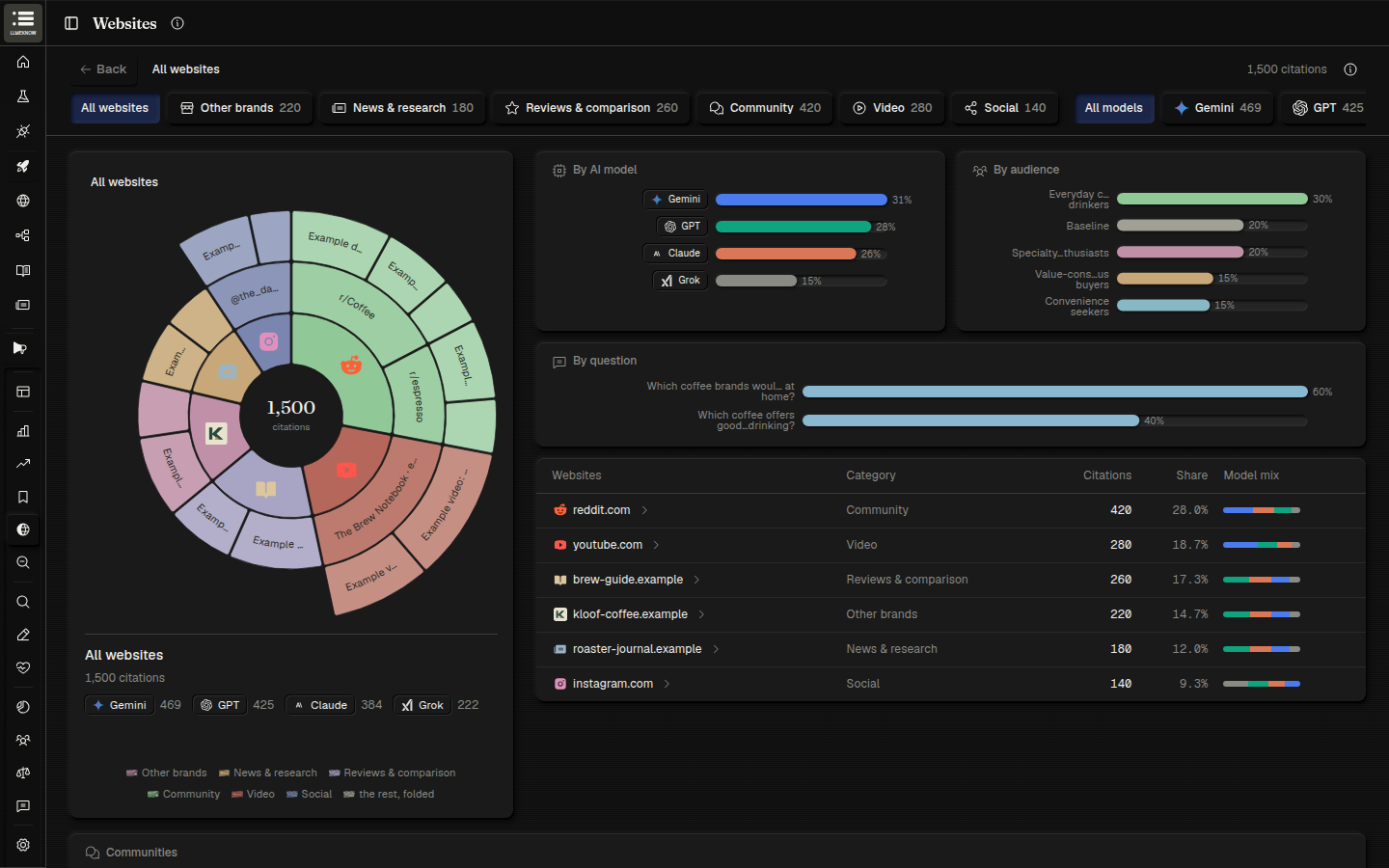
You choose whether the models search the web while answering. With search on, llmeknow records every page they cite. With it off, you see what they say from training alone, and which years and sources they reach for.
Honesty note
AI answers are not a poll
Simulated audience members are not voters, and AI answers do not forecast an outcome. What this measures is the account of an issue that people receive when they ask AI. Where real surveys exist, compare against them; the elections study sets AI answers beside four published surveys.