The short answer
There is no single best tool, because the tools answer different questions
Start with the decision you need to make. A search team may want Google AI Overview coverage alongside search data; a research team may need to inspect responses across models and audience contexts. A single visibility score cannot tell you whether a tool supports either workflow.
The four groups below overlap. Use them to shortlist tools by your main question, then compare the evidence each one lets you inspect.
- Do I show up in Google AI Overviews, alongside my existing search rankings?
- Do ChatGPT, Claude, Gemini, and Perplexity mention me when someone asks about my category?
- What should I change on my site, and did the change work?
- How does the answer differ depending on who is asking?
Category 01
Search platforms with dedicated AI visibility products
Semrush’s AI Visibility Toolkit and Ahrefs’ Brand Radar add AI visibility measurement to established search-marketing platforms. Both describe coverage across AI search experiences and assistants, with brand mentions, sources and prompt tracking. Check the current model and country coverage for the plan you are considering.
Consider them if AI visibility is an extension of search work you already do, and if you want it reported next to the keyword and domain data you already read. Check whether the AI product shares your existing account and reporting workflow.
Do not assume these products only track keywords: both offer AI-specific reporting. Ask which features use a shared prompt database, which let you supply your own questions, and whether the coverage you need is included in your existing subscription.
Category 02
Dedicated AI visibility and source monitors
Profound, AthenaHQ, Otterly.ai, Peec and Menra describe products for monitoring brand mentions and cited sources in AI responses. Their model coverage, collection methods and reporting differ, so compare a sample response and its source record before comparing headline scores.
Some also suggest content changes or help prioritise actions. Ask for a demonstration using questions from your own category, and check the workflow for sharing findings with your team. Access controls, exports and retention can matter as much as model coverage.
Confirm which models are included in your quoted plan and whether you can read complete responses or only aggregate scores. Ask whether collection uses a consumer interface, an API, or another provider: these can produce different results even when they share a model name.
Category 03
Optimisation and audit platforms
ApexGEO describes site audits, AI visibility monitoring and content generation. Several monitoring vendors also offer recommendations or content workflows, so this is a capability to compare rather than an exclusive class of product.
Compare the recommendations with your team’s existing review process. Check whether you can inspect the supporting evidence before committing to a change.
One caution applies to every tool that both measures a problem and sells the fix, ourselves included wherever we recommend a next step: the same system grades your site and scopes the work. That is not dishonest, but it is a reason to check the recommendations against your own judgement.
Category 04
Audience-aware measurement
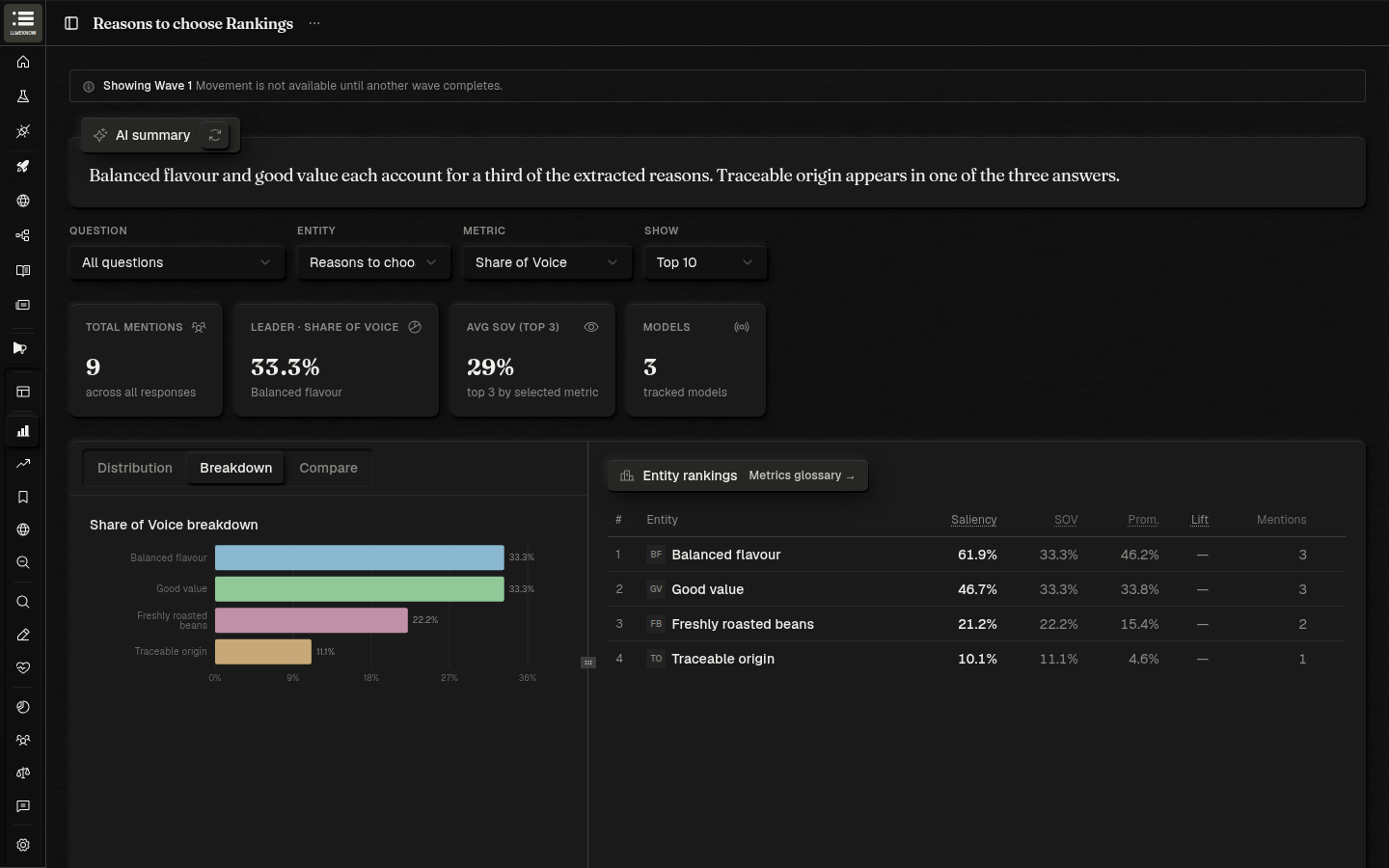
Adding audience or country context can change an AI response. For example, a medical-aid question framed for a family may produce a different shortlist from the same question framed for a graduate. A question without audience context is a useful baseline, not an average of your real customers.
Compare how each tool applies audience context. Does it change the question sent to the model, use location settings, or filter previously collected results? Those approaches answer different questions.
llmeknow supports studies that ask a consistent question set with defined audience segments and a baseline without a segment. AI-generated audience members supply simulated context; they are not recruited buyers or observations of real customer behaviour. Repeating a study in later waves can show how recorded responses changed, but does not by itself prove which marketing activity caused the change.
South Africa
What is actually different about buying this here
A vendor does not need to be based in South Africa to support useful local measurement. What matters is how it collects and describes the responses.
Check whether you can specify South Africa, the relevant language and local competitors. Inspect which sources the responses actually cite; a local question does not guarantee local sources or an accurate answer. Keep the country and collection method visible when comparing results.
Also confirm billing currency, tax treatment, support hours and data-handling terms. Evaluate the product with questions and organisations your team knows well enough to spot mistakes.
Our published South African studies show the questions, audience context and recorded findings. Use them to assess the method and its limits before commissioning your own study.
- Which banks AI systems recommend to South Africans, and how that shifts by audience segment
- How AI answers "best medical aid", and which schemes it volunteers unprompted
- Which news sources AI systems treat as trustworthy in a South African context
How to decide
A shortlist in four questions
Start with your main question, then inspect sample responses and the workflow of each shortlisted tool.
- Already paying for Semrush or Ahrefs, and mainly worried about Google? Start by checking what their AI visibility products cover and whether yours is included or a paid add-on.
- Need to know where you stand across the major assistants? Shortlist the dedicated monitors, and compare them on model coverage at the plan you would actually buy.
- Want the fixes as well as the measurement? Look at the audit and optimisation platforms.
- Do your answers change depending on who is asking, and does that difference matter commercially? Then audience depth is the thing to compare on, and it is worth asking every vendor how far theirs goes.
Before you buy
Four questions to ask any vendor on this list, including us
Ask for the evidence behind the headline score and a quote for the work you intend to do.
- Which models, on the plan I am actually buying? Ask which advertised capabilities are included in the quoted plan.
- Can I read the full raw responses, or only the score? Without the underlying text you cannot check whether a mention was positive, or even about you.
- How is the headline score calculated, and can I see the parts that make it up?
- What does it cost when my usage doubles? Credit-based and per-prompt pricing behave very differently from a flat subscription.