Which phone brand does AI recommend in the US?
llmeknow asks AI assistants the questions your customers ask, on their behalf, and reads the answers. This run was on phone brands in the US. The same run works for any category, any question and any country.
Apple, Samsung and Google Pixel appear in almost every AI answer about which phone to buy in the US. The question is which comes first. We asked five AI models the same question every week for three weeks, as 30 AI-generated US shoppers from six segments, 1,674 answers in all. Apple comes first in three answers out of four. One model leans much harder to Samsung than the rest, and shoppers on a tight budget get a different answer altogether.
Published 18 November 2026
Key numbers
| Brand | Mentioned | Named first | Model that names it first most |
|---|---|---|---|
| Apple | 97% | 74% | Claude and Kimi, 81% each |
| Google Pixel | 96% | 11% | Gemini, 16% |
| Samsung | 96% | 11% | GPT-5.4, 45% |
| Motorola | 32% | 2% | Claude, 12% |
| Fairphone | 19% | 2% | Gemini, 4% |
| OnePlus | 24% | under 1% | Claude, under 1% |
Share of 1,674 answers that name the brand, and that name it before any other brand, counted from the answer text. The last column is the share of that model’s answers. Three weekly waves, 4 to 18 August 2026, with web search on.
What we did
One question, five models, three weeks
A study by llmeknow, not by any of the brands named. The question was “Which mobile phone brand would you recommend?”. We put it to GPT-5.4, Claude Sonnet 4.6, Gemini 3.1 Flash Lite, Grok 4.3 and Kimi K2.6 on 4, 11 and 18 August 2026, with web search switched on, so each answer draws on the model’s training data and on the pages it found that day. Gemini was asked twice over, through the Gemini API and through Google Cloud, and its answers are reported together.
Before each question the model was told who was asking: one of 30 AI-generated US shoppers, five from each of six segments, from budget shoppers at mass-market stores to premium buyers who research before they buy. Each model answered three times per shopper per week, plus a set of answers with no shopper attached, 1,674 answers in all.
This is what the same run gives any brand: how often AI names it, how often AI names it first, how that changes from model to model, from customer to customer and from week to week, and which websites the answers lean on.
First place
Three brands in every answer, one brand first
Apple, Samsung and Google Pixel each appear in 96% to 97% of answers, so being mentioned tells them nothing. Order does. Apple comes first in 74% of all answers. Google Pixel and Samsung come first in 11% each, and no other brand reaches 3%.
Motorola, OnePlus and Fairphone make up the second tier: each is named in a fifth to a third of answers and almost never first.
Models
One model leans to Samsung
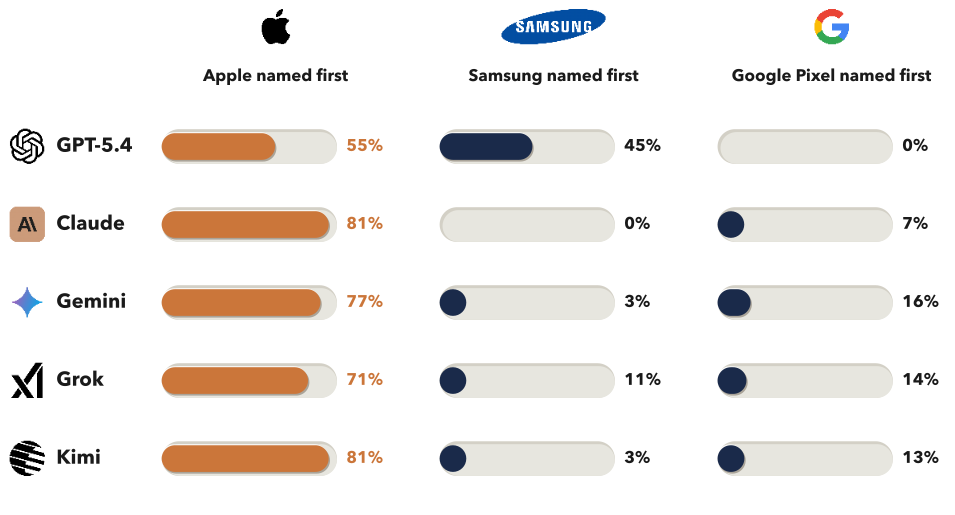
Apple comes first most often for every model, but by very different margins. Claude and Kimi put it first in 81% of their answers, Gemini in 77% and Grok in 71%. GPT-5.4 is the exception: Apple first in 55%, Samsung first in 45%. No other model puts Samsung first in more than 11% of its answers, and Claude never does.
Google Pixel is the reverse: GPT-5.4 never puts it first, while Gemini, Grok and Kimi do in 13% to 16% of their answers. Claude has a second pick of its own, putting Motorola first in 12% of its answers. A brand that checks only one assistant would get a very different picture of where it stands.
Reasons
Samsung’s press and the green bubble
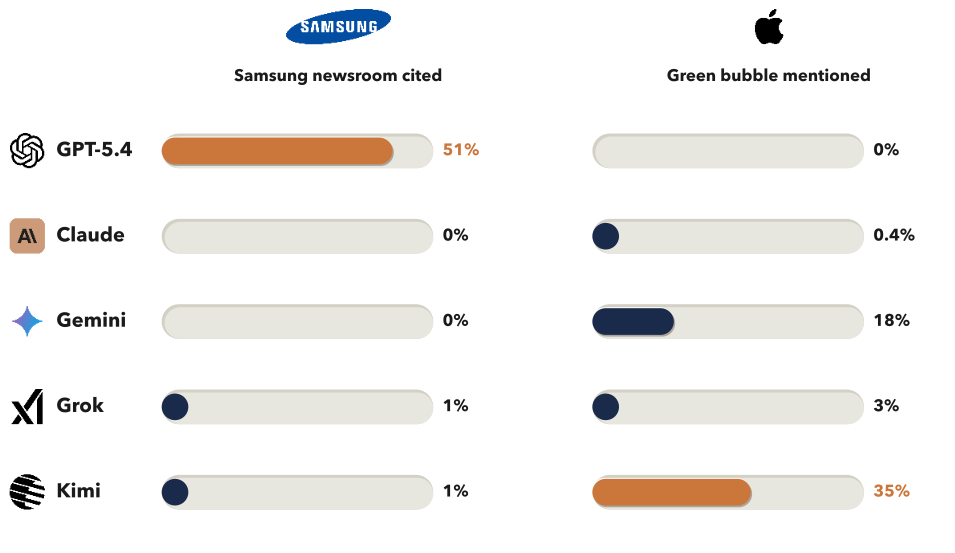
The models do not only rank the brands differently; they argue differently. GPT-5.4 cites Samsung’s own newsroom, news.samsung.com, in 51% of its answers. The other models almost never do, at 1% or less. The model that reads Samsung’s press is the one that puts Samsung first.
Kimi and Gemini argue from social pressure instead. In 35% of Kimi’s answers and 18% of Gemini’s, a reason to choose an iPhone is the “green bubble”: on an iPhone, messages from other iPhones show in blue and messages from Android phones in green, and group chats with an Android user lose features. Among some US consumers, especially younger ones, blue has become a status symbol and green a small social stigma. For the segment of young, social shoppers, the green bubble comes up in 45% of answers. GPT-5.4 and Claude almost never mention it.
Segments
Budget shoppers get a different answer
For five of the six segments, Apple comes first in 77% to 94% of answers. For constrained value hunters, shoppers on a lower income who buy almost entirely on price, it comes first in 3%. Google Pixel takes first place in 47% of their answers, Samsung in 34% and Motorola in 14%. Motorola, almost never first anywhere else, is named in 83% of their answers.
The premium segments carry their own theme. Sustainability or repairability comes up in 86% to 91% of answers for experience explorers, quality curators and wellness seekers, and Fairphone is named in 27% to 44% of them, against 7% or less elsewhere. For quality curators, Fairphone comes first in 10% of answers.
Share of voice by segment. Click a scheme to show or hide its line.
See the same charts for your brand.
Over time
Week to week, the answers hold steady
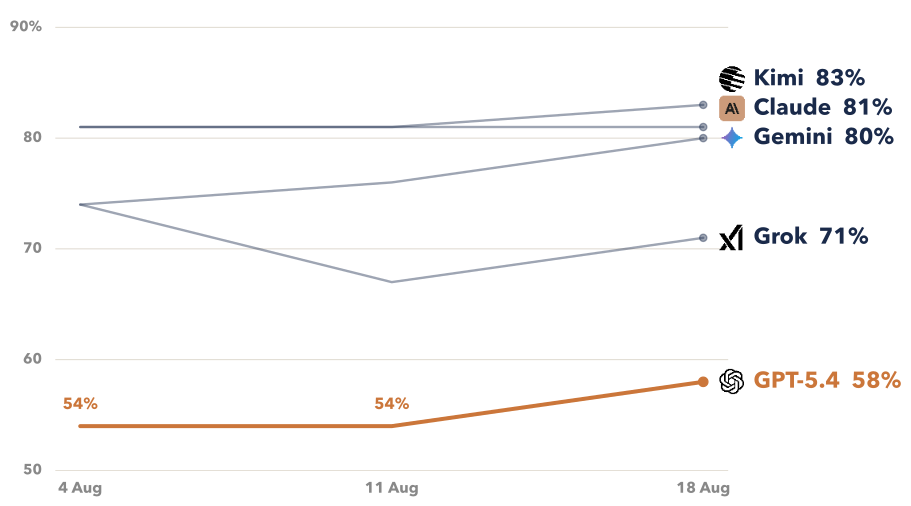
Across the three weeks, no model’s share of answers putting Apple first moved by more than 8 points from one week to the next. GPT-5.4 sat at 54% to 58% every week, well below the others. That stability is the baseline: a later move bigger than this is worth investigating, and one inside it is the normal variation between answers.
A single answer is a sample of one. The same model, asked the same question twice, can name Apple first and then Samsung. Asking many times, every week, is what turns those answers into a measurement.
Sources
Review sites write most of the answer
In the 18 August wave, the models cited 243 websites. Most of what they read is technology press and review sites: TechRadar, PhoneArena, Tom’s Guide, PCMag, Tech Advisor and CNET lead the list. Each model has its own diet. Claude leans on PhoneArena and TechRadar, Gemini on PCMag, YouTube and Reddit, and Grok on CNET.
GPT-5.4 is again the exception. Its most-cited source is Samsung’s newsroom, followed by Tom’s Guide and Consumer Reports. Apple’s and Google’s own sites do not appear among the most-cited sources at all.
All models combined. Filter by model to compare source mixes.
What the answers point to
What a phone brand can take from this
Check every assistant, not one. Apple leads everywhere, but its lead over Samsung ranges from 10 points with GPT-5.4 to 81 points with Claude. A brand’s position is a set of numbers, one per model.
Know which customer you lose. Apple’s lead disappears for budget shoppers, where Google Pixel and Samsung take first place. For Samsung and Google, that segment is where AI already makes their case; for Apple, it is the gap to close.
Publish what the models read. The model that cites Samsung’s newsroom is the one that puts Samsung first. Review sites supply most of what the models read, and a brand’s own clear, current pages can join them.
Method
How this study was run
One question, “Which mobile phone brand would you recommend?”, was put to five AI models on 4, 11 and 18 August 2026, in English, with web search switched on. Before each question the model was told about the person asking: one of 30 AI-generated US shoppers, five from each of six segments. Each model answered three times per shopper per week, plus three times with no shopper attached: 93 answers per model per week, 186 for Gemini, which was asked through two services, and 1,674 in all.
Brand figures on this page are counted from the answer text. A brand is mentioned when its name, or a product line such as iPhone, Galaxy or Pixel, appears anywhere in an answer, and named first when it appears before any other phone brand. Reasons are counted the same way, from the words in each answer. Sources are the websites each answer cites.
Limits
What this can and cannot tell you
This is a reading of AI answers. Nobody asked a shopper anything, and a brand that comes first in 74% of answers has not won 74% of any market. It is the share of AI answers that put it first, which is what a shopper asking an AI assistant will meet.
“Named first” means the first brand the answer names, which is usually, but not always, the brand it recommends most strongly. An answer that opens by comparing two brands counts for whichever it names first.
Each segment rests on 270 answers and each model on 279 (558 for Gemini), so gaps of a few points between two models or two segments can be chance. Web search was on, so a later wave can move if the pages the models read change.
The same design runs on any category, any country and any set of segments or questions.
Run this study on your market.
Explore the platform for 30 days with no subscription fee and no card. You pay only for the AI responses you generate, with the estimated cost shown before anything runs. No subscription starts unless you choose one.