Which alcohol-free drinks does AI recommend in the UK?
llmeknow asks AI assistants the questions your customers ask, on their behalf, and reads the answers. This study was on alcohol-free drinks in the UK. The same study works for any category, any question and any country.
More people in the UK are drinking less, or not at all, and the alcohol-free shelf has grown to meet them. A growing number of shoppers now ask an AI assistant what to buy. We asked six AI models one question 306 times, each time as one of 50 UK drinkers from ten consumer segments. Lucky Saint is the brand AI names most and names first most. Most models put it first, but not all, the reasons change with the person asking, and one brand gets a lift from its own website.
Published 18 November 2026
Key numbers
| Brand | Mentioned | Named first | Model that names it first most |
|---|---|---|---|
| Lucky Saint | 63% | 27% | Gemini, 39% |
| Seedlip | 54% | 11% | Gemini, 24% |
| Guinness 0.0 | 45% | 8% | ChatGPT, 29% |
| Heineken 0.0 | 33% | 6% | Kimi, 18% |
| Everleaf | 28% | 5% | ChatGPT, Gemini and Grok, 10% each |
| CleanCo | 24% | under 1% | ChatGPT and Gemini, 2% each |
| IMPOSSIBREW | 10% | 4% | Grok, 12% |
Share of 306 answers that name the brand, and that name it before any other brand, counted from the answer text. The last column is the share of that model’s 51 answers. Asked 6 November 2026 with web search on.
What we did
One question, six models, ten kinds of drinker
A study by llmeknow, not by any of the brands named. The question was “What are the best alcoholic drink alternatives?”. On 6 November 2026 we put it to GPT-5.6 Luna, Claude Sonnet 5, Gemini 3.1 Flash Lite, Google AI Summary, Grok 4.3 and Kimi K2.6, with web search switched on, so each answer draws on the model’s training data and on the pages it found that day.
Before each question the model was told who was asking: one of 50 AI-generated UK drinkers, five from each of ten consumer segments. The segments cover the main reasons people drink less: health and fitness, skipping the hangover, pregnancy, medical reasons, faith and culture, driving, saving money, curiosity about flavour, a sober-curious lifestyle, and “zebra striping”, alternating alcoholic and alcohol-free drinks on a night out. Each model answered once per drinker, 51 answers per model and 306 in all, including six with no drinker attached.
This is what the same study gives any brand: how often AI names it, how often AI names it first, how that changes from model to model and from customer to customer, and which websites the answers lean on.
Mentions
Lucky Saint is named most, and named first most
Lucky Saint appears in 63% of the answers, Seedlip in 54% and Guinness 0.0 in 45%. No other brand reaches 35%. Beer, spirit alternatives and wine alternatives all appear near the top, so the answers treat the category as a whole shelf rather than one drink.
Being named is not the same as being named first. Lucky Saint comes first in 27% of all answers, more than twice as often as any other brand. Guinness 0.0 appears in 45% of answers but comes first in 8%, and CleanCo appears in almost a quarter and comes first in fewer than 1%. A brand on the list is part of the conversation; the brand at the top of the list is the recommendation.
First place
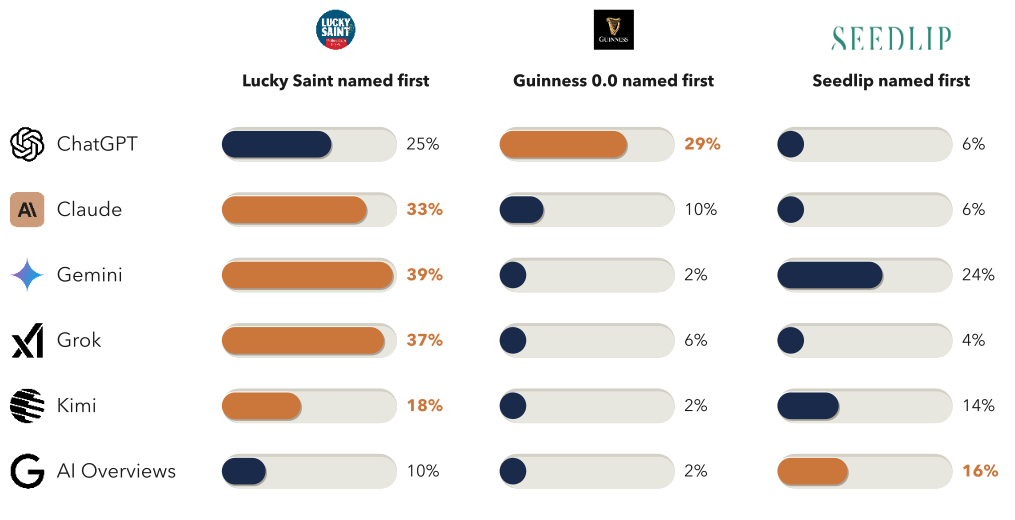
Most models put Lucky Saint first, but two do not
Lucky Saint comes first most often for Gemini (39% of its answers), Grok (37%) and Claude (33%), and level with Heineken 0.0 for Kimi (18% each). ChatGPT is the exception: it starts with Guinness 0.0 in 29% of its answers, against 2% to 10% for every other model. Google AI Summary starts with Seedlip most often (16%), and leaves more answers without any brand at the top.
For a drinks brand, “how do we rank in AI?” has no single answer. It has one answer per model, and customers do not all use the same one. A brand that only checks the assistant its own team uses will miss where it is weak.
Reasons
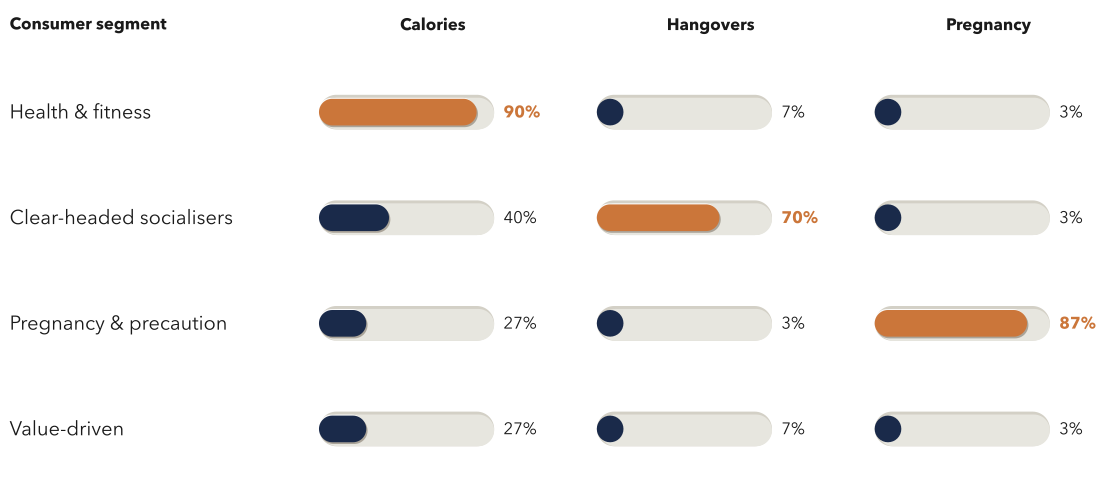
The same drinks, sold for different reasons
The brands change little from segment to segment: Lucky Saint or Seedlip is the most-mentioned brand for all ten. What changes is the reason the answers give. Calories come up in 90% of answers for health and fitness drinkers, against 27% to 40% for the other segments shown. Hangovers come up in 70% of answers for social drinkers who want to skip them. Pregnancy comes up in 87% of answers for people being careful in pregnancy.
That is the gap between “does AI recommend us?” and “what does AI say we are for, and to whom?”. The second question is the one a brand can act on, because it says which claims the answers repeat for each kind of customer.
See the same charts for your brand.
Segments
When alcohol must be zero, 0.0 beers move up
For drinkers who must avoid alcohol completely, the answers reach for 0.0% beers more often. Heineken 0.0 appears in 60% of answers for faith and culture abstainers and 53% for drivers, against 13% for flavour-curious drinkers and 17% for health and fitness drinkers. Lucky Saint, which more than half of the answers that name it describe as 0.5%, is named in 87% of answers for health and fitness drinkers and 47% for people being careful in pregnancy, where Seedlip leads at 70%.
Use the toggles to compare brands across all ten segments. Each segment rests on 30 answers, so read the large gaps, not the small ones.
Share of voice by segment. Click a scheme to show or hide its line.
Sources
AI reads review sites and the press; one brand’s own site breaks through
The six AI models cited 346 websites across the 306 answers. The most-cited is practicallyclear.com, followed by Wikipedia, the Independent, the magazine archive issuu.com and the charity Alcohol Change UK. Each model has its own diet: Claude leans on Wikipedia and magazine round-ups, Gemini on Alcohol Change UK and BBC Good Food, and ChatGPT on Drinkaware and Which?.
Two brand websites stand out. impossibrew.co.uk is the sixth most-cited site, 88 times, and Claude and Grok name IMPOSSIBREW first in 10% and 12% of their answers; the other four models never do. ChatGPT cites guinness.com 28 times, and it is also the only model that often names Guinness 0.0 first. Neither is proof that one causes the other, but a brand’s own pages are clearly part of what some models read.
All models combined. Filter by model to compare source mixes.
What the answers point to
What a drinks brand can take from this
Check every assistant, not one. Lucky Saint leads overall, but ChatGPT starts with Guinness 0.0 and Google AI Summary with Seedlip. Each brand’s position is a set of numbers, one per model, and the weakest one is where to start.
Know what you are recommended for. The answers attach different reasons to different drinkers: calories for the health-minded, hangovers for social drinkers, alcohol content for anyone who must avoid alcohol completely. Strength claims matter most where alcohol must be zero, which is where 0.0% beers gain ground on 0.5% ones.
Make your own pages worth citing. Specialist review sites, the press and health charities supply most of what the models read. Brands whose own sites are cited, such as IMPOSSIBREW and Guinness, are named first more often by some of the models that cite them. Clear, current product pages with honest strength, calorie and stockist information give the models something to quote.
Method
How this study was run
One question, “What are the best alcoholic drink alternatives?”, was put to six AI models on 6 November 2026, in English, with web search switched on. Before each question the model was told about the person asking: one of 50 AI-generated UK drinkers, five from each of ten consumer segments. Each model answered once per drinker, plus once with no drinker attached, 51 answers per model and 306 in all.
Brand figures on this page are counted from the answer text. A brand is mentioned when its name appears anywhere in an answer, and named first when its name appears before any other brand on a list of 46 alcohol-free brands. Product lines count towards their brand, so “Guinness 0.0 Draught” counts for Guinness 0.0. Reasons are counted the same way, from the words in each answer. Sources are the websites each answer cites.
Limits
What this can and cannot tell you
This is a reading of AI answers. Nobody asked a drinker anything, and a brand that comes first in 27% of answers has not won 27% of any market. It is the share of AI answers that put it first, which is what a shopper asking an AI assistant will meet.
“Named first” here means the first brand the answer names, which is usually, but not always, the brand it recommends most strongly. An answer that opens by comparing two brands counts for whichever it names first.
The study is one wave. Each model gave 51 answers and each segment got 30, so differences of less than about 15 points between two models or two segments on one brand can be chance. Web search was on, so a later wave can move if the pages the models read change.
The same design runs on any category, any country and any set of segments or questions.
Run this study on your market.
Explore the platform for 30 days with no subscription fee and no card. You pay only for the AI responses you generate, with the estimated cost shown before anything runs. No subscription starts unless you choose one.